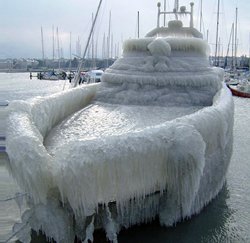
 Protect your boat from winter damage. Protect your boat from winter damage.
In colder climates, boat engine room heaters are needed to protect your boat's engine during cold weather if you don't winterize your engine. These heaters are also useful in milder climates that may experience occasional unexpected cold snaps. If the boat is on a trailer or on blocks, it will get much colder than if it stays in the water and may suffer a cracked block when the temperature changes. Engine room heaters can be set to cycle on and off during weather between 40 degrees and 55 degrees. You can cover the vents of bilge blower with a removable cover when using the heater to keep in more of the heat. Trying to heat with a normal space heater or a light bulb in the engine compartment is not recommended because of the danger of sparking.
Pros's
- Engine compartment heaters are much safer than conventional space heaters and light bulbs.
- Engine compartment heaters can save money if you don't need to winterize your boat.
- Engine compartment heaters can protect your engine during unexpected cold snaps.
- Installed heaters can add resale value to your boat.
Con's
- An improperly sized engine compartment heater will not protect your engine.
Experts recommend the use of engine room heaters for boat engines that are not winterized, but that may be exposed to wide temperature changes or occasional cold snaps that could crack the engine. Using an engine room heater is much safer than trying to keep your engine warm with a standard space heater or light bulb. The engine will get much colder if the boat is on a trailer or on blocks than it would if it was in the water. The engine compartment heater can be set to cycle when temperatures are between 40 degrees Fahrenheit and 55 degrees Fahrenheit. Keeping the bilge pump vents covered when using the heater is also an energy-saving recommendation. |




 Boat Outfitting

