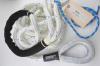
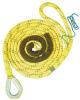
Modern boat mooring pendants minimize potential detachment loss by maximizing
proven connection gain. Since the introduction of high-energy-absorbing double-braid
nylon mooring pendants, the security of boat moorings have dramatically improved.
All pennants have a stainless steel thimble on one end and a soft eye on the other
end with a tag line. A moveable chafe sleeve is installed to allow adjustment based
on choke position.
Sunlight/UV:
Very little degradation from sunlight. Can be used outside over long term if inspected
regularly.
Chemicals:
Nylon will degrade with strong oxidizing agents, mineral acids, and 90% formic acid.
May discolor when exposed to high levels of carbon dioxide. Polyester has good resistance
to most chemicals, except 95% sulfuric acid and strong alkalines at boil.
Heat:
Nylon melts at 460°F with progressive strength loss above 300°F. Polyester melts
at 480°F with progressive strength loss above 300°F.
Dielectrics:
Good resistance to the passage of electrical current. However, dirt, surface contaminants,
water entrapment, and the like can significantly affect dielectric properties. Extreme
caution should be exercised any time a rope is in the proximity of live circuits.
Sheaves:
Recommended sheave diameter to rope diameter is 8:1.
Working Loads:
No blanket safe working load (SWL) recommendations can be made for any line because
SWL's must be calculated based on application, conditions of use, and potential
danger to personnel among other considerations. It is recommended that the end user
establish working loads and safety factors based on best practices established by
the end user's industry; by professional judgment and personal experience; and after
thorough assessment of all risks. The SWL is a guideline for the use of a rope in
good condition for non-critical applications and should be reduced where life, limb,
or valuable property is involved, or in cases of exceptional service such as shock
loading, sustained loading, severe vibration, etc. The Cordage Institute specifies
that the SWL of a rope shall be determined by dividing the Minimum Tensile Strength
of the rope by a safety factor. The safety factor ranges from 5 to 12 for non-critical
uses and is typically set at 15 for life lines. |